
SmartVoyage
AI-first travel planning, from trip idea to confirmed itinerary, together.
Case Study
International travel planning is fragmented. SmartVoyage is an AI trip coordinator that helps groups plan, align on budgets, book, and recover from disruptions, in one system. I designed the full product experience, from conversational intent capture to post-booking disruption handling.
My Role
Product Design (end-to-end)
Brief
Design Challenge
Create an AI-first travel planning experience that supports trip discovery, collaborative group planning, budget alignment, booking decisions, dynamic itineraries, and post-booking disruption handling.
Context
Problem Framing
International trip planning is fragmented. People switch between search tools, booking sites, spreadsheets, and group chats, and none of it talks to each other. Groups add another layer of complexity: conflicting budgets, mismatched preferences, and last-minute changes with no clear owner.
Opportunity
An AI-first system can reduce decision fatigue by guiding users through planning, helping groups align faster, and actively managing recovery, so the product works for you, not the other way around.

User Roles
Trip Organizer: starts the trip, invites others, drives group decisions.
Traveler / Contributor: adds preferences, budget, and approvals.
Solo Traveler: uses the assistant independently to discover, book, and manage

Goals
Help users move from trip idea to confirmed plan.
Reduce fragmentation across planning, booking, and itinerary management.
Support group coordination without relying on scattered chats.
Help travelers understand tradeoffs across budget, comfort, and constraints.
Make post-booking changes and disruptions easier to manage.

Strategic Framing
Design Principles - The AI Angle
AI captures intent. UI makes it editable.
Guide, don't overwhelm.
Design for groups, not just individuals.
Make tradeoffs explicit.
Recovery is part of the product.



Information architecture
App flow
Most travel apps are built around booking transactions. SmartVoyage is structured around the trip lifecycle — from early intent to post-disruption recovery. This meant rethinking what "the product" even is: not a search engine, not a booking tool, but a coordinator that holds the whole trip in one place.

Screens
Core Flow

Screen 1: Landing
The entry point leads with a bold value proposition and an open AI prompt, no dropdowns, no mandatory fields. The hero communicates the product's ambition: orchestration, not just search.
Design decision: A dark, full-bleed hero signals this is a product, not a booking widget. The AI prompt is wide and open-ended, the user can type anything from "7-day Japan trip for 4 in April" to "where should we go?" and the system responds intelligently either way.
Click to pause animation

Screen 2: Plan a trip
Once intent is captured, the experience shifts from conversation to structured UI. Destination, duration, dates, budget per person, group size, travel style, and flight preferences are editable fields, not a chat thread. A live trip summary panel on the right updates as the user fills in details.
Design decision: The hybrid model in action, AI captures open intent, structured UI makes it editable and scannable. This prevents the friction of re-typing in a chat and gives users confidence that the system understood them correctly before generating options.
Click to pause animation
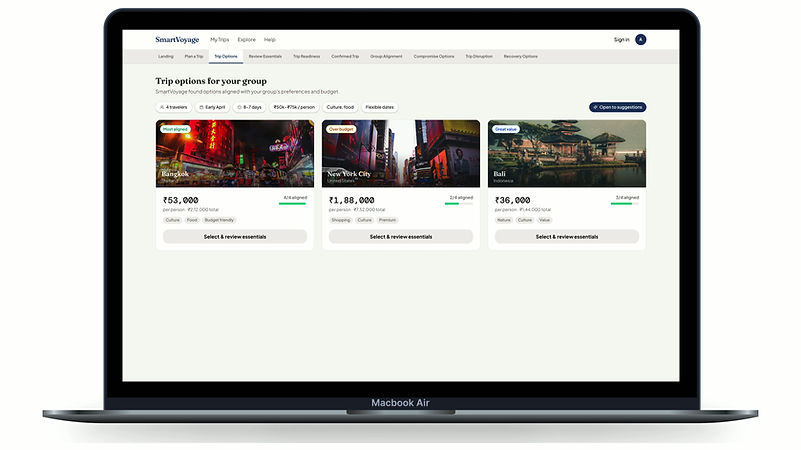
Screen 3: Trip options for your group
Three destination cards, Bangkok, Vietnam, Dubai, each with real photography, a price range, and a "why it matches" summary. A quick comparison table below lets the group evaluate across cost, vibe, effort, and group fit without opening new tabs.
Design decision: Photography is intentional, it makes the choice feel real, not abstract. I avoided ranking purely by price because that undermines the group-fit logic. The AI leads with the destination it recommends and explains why, giving the group something to react to rather than a blank matrix to fill.
Click to pause animation

Screen 4: Review and select essentials
Flight options and hotel options are shown on the same screen, with shared trip context (traveler count, dates, budget) visible throughout. Selecting a flight immediately updates the hotel availability and cost estimate. A "Confirm to essentials" CTA only activates once both are chosen.
Design decision: Most booking products treat flights and hotels as separate journeys with separate confirmation flows. Combining them on one screen, with live cost updating, eliminates the back-and-forth that causes drop-off and budget miscalculation in group trips.
Click to pause animation
Screen 5: Trip readiness
Before confirming, SmartVoyage runs a readiness check, a lightweight checklist covering visa requirements, passport validity, traveler details, and any pending group approvals. Each item is marked complete, needs review, or flagged as missing. The user can proceed only when critical items are resolved.
Design decision: This screen exists because international group travel has real compliance requirements that most products ignore until something goes wrong. Making readiness a visible, gated step — rather than a buried FAQ — means the product actively reduces risk for the user before they commit money.
Click to pause animation

Click to pause animation
Screen 6: Confirmed trip
The confirmed view shows the full trip summary, travelers, dates, flight, hotel, budget, alongside a day-by-day itinerary. Each day is expandable with activities, timings, and suggestions. Users can add activities, adjust the plan, and track the trip from this single view.
Design decision: The confirmed state is not a receipt, it's a living document. The itinerary is editable post-booking so the group keeps using the product, not a PDF or group chat. This also sets up the disruption recovery flows: because SmartVoyage holds the full plan, it can detect and respond to changes automatically.
Group Alignment
Budget
The hardest part of group travel isn't booking, it's alignment. Most tools assume one person makes all the decisions. SmartVoyage introduces a shared planning layer where every traveler's preferences, budget range, and constraints are visible in one place, and the AI surfaces the overlap, not just the conflict.

Each traveler's preferences and budget range are shown as individual cards. A shared overlap range is calculated automatically, ₹70k–₹75k/person works for 3 of 4 travelers with minimal tradeoffs. Conflicts are named, not hidden.
Decision: I showed individual ranges as bars rather than a single merged number because groups need to see why the overlap exists, not just what it is. Transparency builds trust.


Product thinking depth
Disruption and change
The hardest part of group travel isn't booking, it's alignment. Most tools assume one person makes all the decisions. SmartVoyage introduces a shared planning layer where every traveler's preferences, budget range, and constraints are visible in one place, and the AI surfaces the overlap, not just the conflict.
SmartVoyage detects the cancellation automatically and maps every dependent booking, connecting flight, hotel check-in timing, airport pickup, Day 1 itinerary. The impact chain is shown visually so nothing is hidden.
Decision: I avoided a generic "your flight was cancelled" alert. The product shows exactly what it found and what it's reviewing, building trust through transparency.

Three flight alternatives are surfaced, Least disruption, Lowest additional cost, Earliest next arrival, each with a clear cost delta, trip impact summary, and a "Why SmartVoyage recommends this" explanation.
Decision: Options are ranked by disruption, not just price. The AI makes a recommendation and explains it, so the traveler can make an informed choice fast, not spend 20 minutes comparing tabs.
